There are at least seven HCPCS codes for prescription digital therapeutics. A9291. A9292. A9294. E1905. G0552. G0553. G0554.
Aetna’s clinical policy lists all seven as not covered.
The same policy names 23 individual products as experimental, investigational, or unproven. Products with FDA authorizations. Products with published randomized trials. The one thing Aetna covers in the whole category is a fertility-awareness contraception app, and only because a federal preventive care mandate requires it.
So the code exists. The FDA said yes. The trial worked. And the answer is still no.
That’s the part most teams don’t see coming, and it usually surfaces late – in a meeting where someone asks when revenue starts and nobody has a good answer.
Coverage is a separate decision. Different people, different standard, written down in a document most companies building health products have never opened. A payer evidence dossier is what you bring to that decision.
Payer medical policies are public. Aetna, Cigna, and UnitedHealthcare all post theirs. Almost nobody building a health product has read one end to end, which is strange, because it’s the document that determines whether the product has a business.
They’re predictable, too. The same skeleton shows up every time: scope, the coverage position, a list of excluded products, definitions, codes, a description of the service, the clinical evidence, society guidance, FDA status.
Two parts matter more than the rest.
The exclusion list names products, not categories. If a competitor is on it, that’s the context you’re being read in.
And the clinical evidence section is most of the document. UnitedHealthcare’s policy on cell-free fetal DNA testing runs 22 pages. The evidence review starts on page 3 and doesn’t finish until page 18. The coverage rule itself takes a paragraph.
Everything else justifies that paragraph. Which means your dossier has to be answerable in three places: the coverage position, the clinical evidence, and the society guidance.
Read Aetna’s background section on any product and the pattern is unmistakable. Named study, named authors, named endpoint, then an explicit judgment on whether the evidence is good enough. In at least one case it cites a positive trial and then, immediately after, a later study that failed to reproduce the effect.
That’s what a payer’s review actually does. It reads the whole file, including the parts you’d rather it skipped, and writes down a conclusion.
Cigna is even blunter about the reasoning. Here’s the sentence that declined coverage for one product:
“The current evidence base for the Freespira System consists of a small number of single-arm, uncontrolled studies with no randomized or comparative trials identified.”
Look at what that isn’t about. Not the mechanism. Not the innovation. Not the clinical need.
Study design. Comparator. Publication status. Three things you decide when you design the trial, and three things that are nearly impossible to fix afterward.
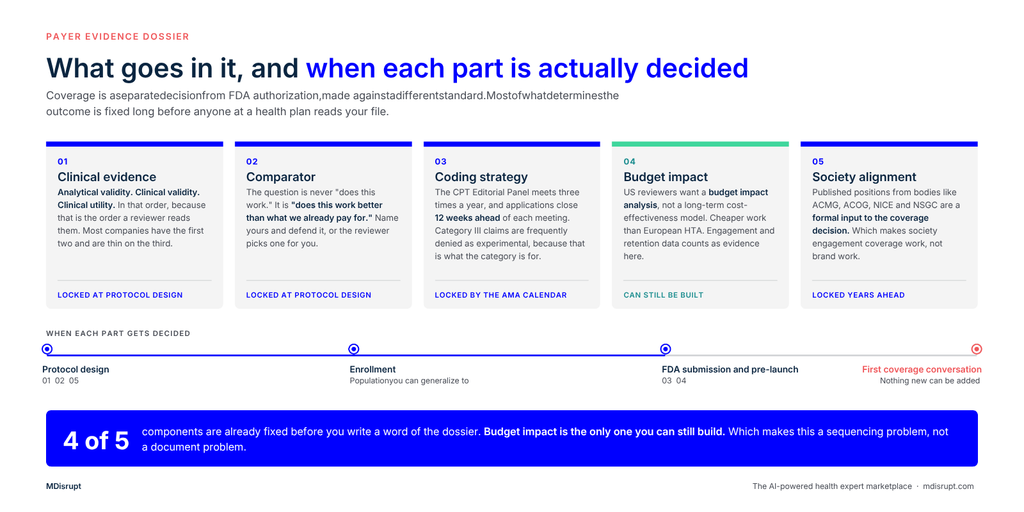
Use those three as your headings, in that order. Most companies have the first two and are thin on the third. Clinical utility asks whether knowing the result changes what a clinician does, and whether that change helps. It’s the hardest evidence to generate and the most common reason a dossier fails.
Which category you land in matters more than the timing. Category I requires all five AMA criteria, including FDA clearance and clinical efficacy documented in the literature. Category III asks only that the service is performed in humans, plus one supporting signal. That asymmetry is why early-stage companies end up in Category III, where payers frequently deny claims as experimental, because that’s what the category is for.
FDA runs a Payor Communication Task Force, and its stated reasoning is the clearest description of this problem by anyone in government:
“data that medical device manufacturers submit to FDA to demonstrate the safety and effectiveness of a medical device may not always overlap with the data needed by payors to make coverage determinations.”
Its Early Payor Feedback Program introduces you to payers before authorization, so trials can be designed to satisfy both. Aetna, Cigna, Kaiser Permanente, UnitedHealthcare, CMS, and NICE Advice are all on the roster. As of December 2024, FDA had matched 158 requests. Seven manufacturers attracted no interested payer at all.
The companion program, Parallel Review with CMS, has the most useful number here. There have been 97 formal requests. Two devices have finished it: Cologuard in 2014 and FoundationOne CDx in 2017.
Parallel Review isn’t a shortcut. It’s a narrow instrument that has worked twice.
The NIH’s guidance on device reimbursement doesn’t hedge: “developing a strategy for obtaining them should begin early, and well in advance of Food and Drug Administration (FDA) clearance or approval.”
Here’s why. Almost everything that determines your coverage outcome gets decided years earlier. Your comparator is set in protocol design. Your clinical utility endpoints are set in protocol design. The population you can generalize to is set during enrollment. Whether a society has taken a position depends on their committee calendar, not yours.
And the clocks compound. A national coverage determination runs on a six-month statutory clock, or nine months with an external technology assessment, plus a 30-day comment period and up to 60 more days to finalize. A CPT application sits 12 weeks ahead of a meeting held three times a year.
None of those clocks start when you feel ready. They start when you file. And you can’t file evidence you didn’t collect.
We’ve done this work with diagnostics companies building payer strategy from the ground up. It isn’t a document. It’s a sequence of decisions made in the right order, guided by experts.
The dossier isn’t really a document problem. It’s a sequencing problem disguised as a document. By the time you’re writing it, most of what decides the outcome is already fixed – the comparator, the endpoints, the population, whether a society has taken a position. Companies that treat market access as a launch activity find that out during launch.
The ones that get covered treat it as a development activity, and bring in people who’ve read these documents from the other side of the table.
That last part is the hard bit, and it’s what we built MDisrupt for. The people who can tell you whether your comparator will survive review, or which endpoints a medical policy team will care about, are market access leaders, payer strategists, and coding and coverage experts who have sat on the other side of these decisions. Most companies start with a single call to pressure-test a plan they already have, and we can usually match you within 24 to 72 hours. If that’s useful, you can find your expert on the MDisrupt platform.