A heart-failure monitor with great data never took off in the market. A pricier, more invasive implant did, because it arrived with a funding mechanism and a care model.
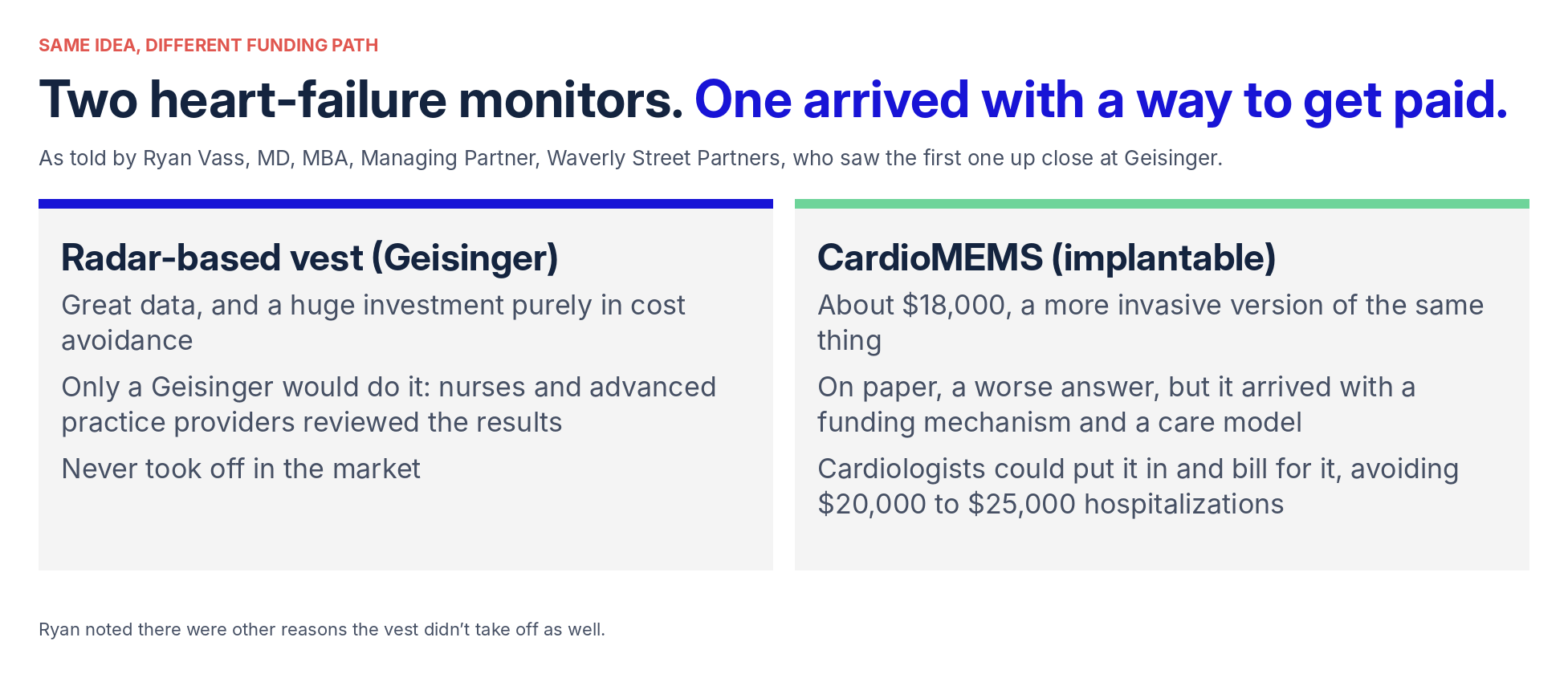
Ryan Vass, MD, MBA, Managing Partner at Waverly Street Partners, saw the first device up close during his time at Geisinger: a radar-based vest that patients wore to detect fluid in the lungs, meant to anticipate heart failure readmissions before they happened. It had great data, but as Ryan put it, only a Geisinger would do it, because it took a whole machinery of nurses and advanced practice providers reviewing the results. It was a huge investment, purely in cost avoidance, and it “just didn’t really go anywhere, despite being an incredible technology.”
The second device, CardioMEMS, is an implantable version of the same idea, and it costs about $18,000. In Ryan’s words, “on paper, it’s a worse answer, but it arrived with a funding mechanism.” Cardiologists could put it in and bill for it, and even at that price it still resulted in downstream savings, because it avoided $20,000 to $25,000 hospitalizations.
His conclusion: “You cannot just expect, if it improves outcomes, even if it saves money, that it’s gonna have market success.”
That one story captures a problem that runs through health technology. We asked four experts what it takes to avoid the first outcome: Lisa Suennen of American Heart Association Ventures, Stacey Popko, MD, MBA, an expert on clinical coverage and clinical AI validation, Richa Gujarati, SVP of Product and GTM at HeartBeam, and Ryan. Their examples come from cardiovascular AI, but the lessons apply to any health product that needs someone else to pay for it: diagnostics, digital therapeutics, remote monitoring, and devices.
Here’s what stood out.
Payers ask a different question than the FDA
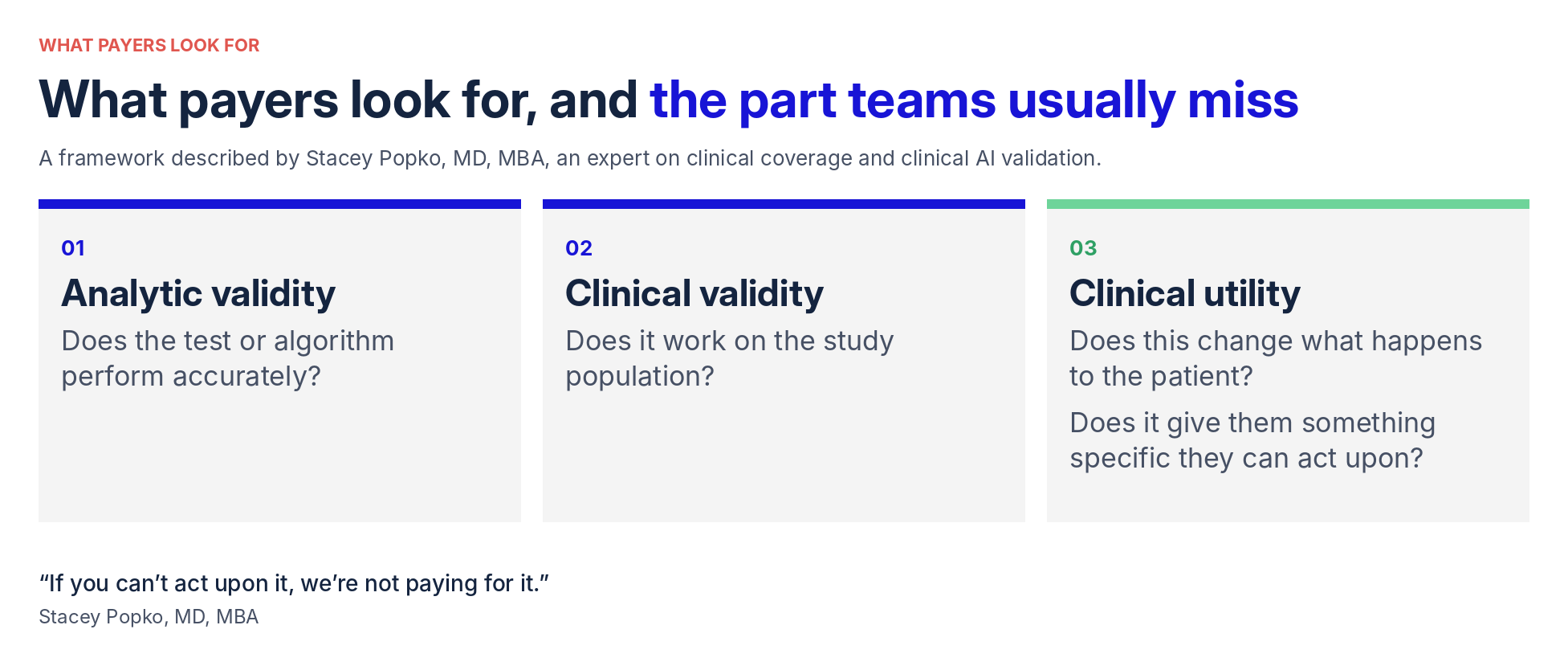
Stacey Popko put the payer standard in one line: “If you can’t act upon it, we’re not paying for it.”
She described a framework of three things payers look for: analytic validity, clinical validity (does it work on the study population?), and clinical utility. Utility is the key one: does this change what happens to the patient, and does it give them something specific they can act upon?
Teams usually haven’t thought about doing anything to prove clinical utility. Without it, as Stacey put it, “no one’s gonna pay for it.”
Real savings can still be too small to matter
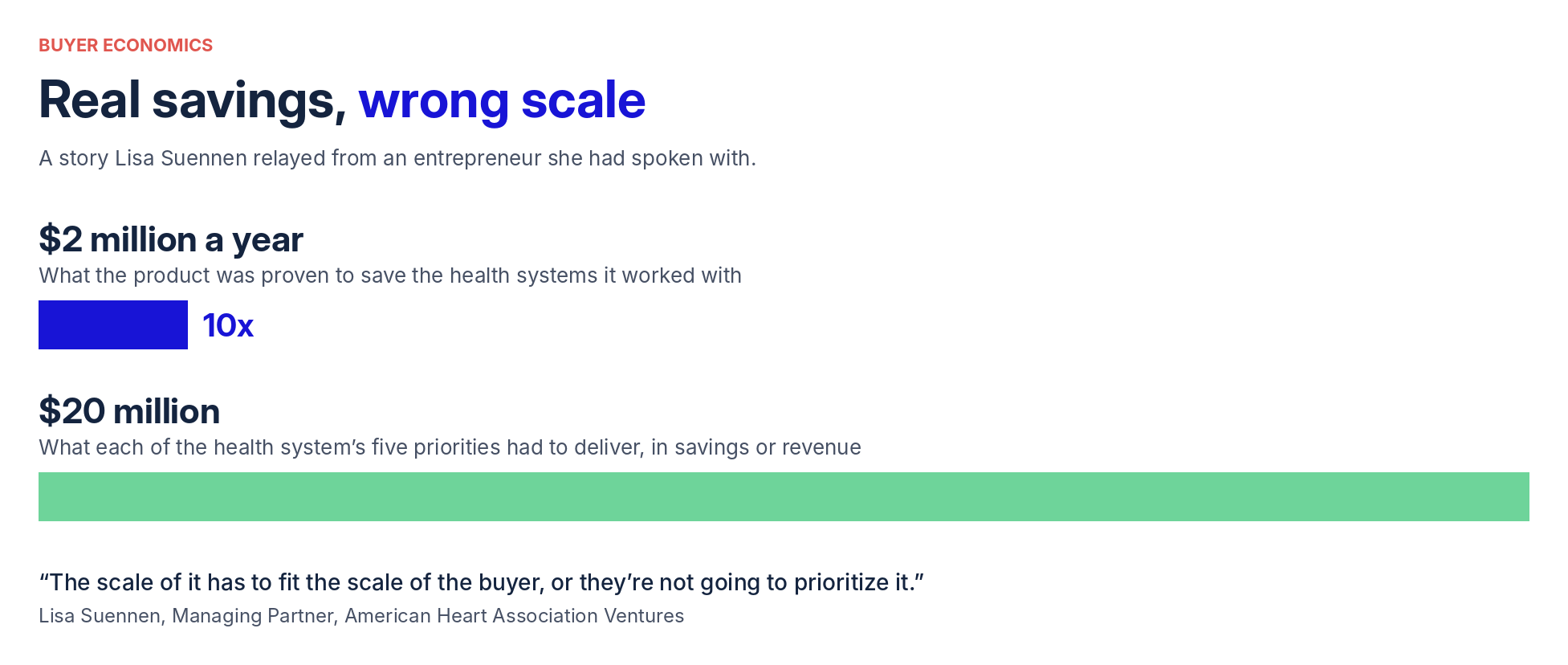
Lisa relayed a story from an entrepreneur she had spoken with. His company had definite proof that its product would save the health systems it worked with $2 million a year. The response was that it was like peanuts. The health system could only do five things that year, and each one had to deliver $20 million in savings or revenue to get attention.
Her takeaway: “the scale of it has to fit the scale of the buyer, or they’re not going to prioritize it.”
Ryan added a second problem, timing. In his words, “people severely discount year two and year three revenue,” and an accountable care organization may keep a quarter of every dollar it saves, so a payoff five to seven years out gets heavily discounted. His advice to founders was to understand each buyer’s value equation, time horizon, organizational goals, and the micro-incentives of the operators who make the purchase decision.
Richa described how her teams have won with products whose clinical payoff is five to seven years out: show that the product drives efficiency, reduces waste and repeated testing, and “you can make the economic argument there as well.”
Software and hardware follow different reimbursement paths
Hardware has been “a little more straightforward as a pathway,” Richa said, though much longer. You go after your own CPT code, try for Category III, and then convert it into a permanent code. Software has struggled, until recently.
She gave a concrete example from her Apple Watch days. Her team had built out software-as-a-medical-device capabilities, but they didn’t qualify under the remote patient monitoring code, because they weren’t regulated hardware, and that’s one of the requirements for RPM billing. A team can build real clinical features and still find out too late that the code they were counting on was written for something else.
That is starting to change. Richa pointed to the new AI-specific codes and said CMS is starting to look at AI-based ECG codes very favorably. Ryan added that cardiovascular has a bit of an edge, because the costs avoided are often more immediate and bigger.
The policy debate is far from settled
On how CMS should pay for standalone AI and software services, Ryan argued for paying for displacement: “what care are you displacing?” He added a lesson from remote patient monitoring: guardrails matter, and so does enforcing them. A CMS study of RPM found that most of the time requirements “just were not enforced and not done.”
Richa offered what she called a controversial take. She worries about overuse and abuse of the new AI-based codes, since they aren’t tied to a specific procedure, and about CMS “coming down hard, and killing it altogether,” as she sees it starting to do with remote monitoring.
Lisa has seen the pattern before. She invested in what she called the very first remote patient monitoring company, back in 1998, and it didn’t do well because there was no payment for what it did. Once payment finally arrived, she said, “we started to see… more flowers blooming than we needed to see,” and it “became a revenue model, not a clinical value model.”
The open question: will patients pay out of pocket?
Richa believes the consumer pay model is here to stay, pointing to the concierge market and preventative cardiology moving away from fee-for-service billing. Her caution for founders: if a reimbursement pathway is on your roadmap, be careful about cash pricing, because there’s a tendency to price too low, and “you will set that anchor,” especially for a CPT code.
Lisa disagrees. It’s true in some cases, she said, but she’s still a skeptic, because “most people don’t want to think of themselves as a patient.” She sees people paying for wellness, exercise, and fertility, and thinks people are less willing when it relates to chronic illness. Stacey’s answer is “it really depends.” The market has changed, she said, but you have to be good at communicating value to someone who isn’t necessarily financially or clinically savvy.
What to do before launch
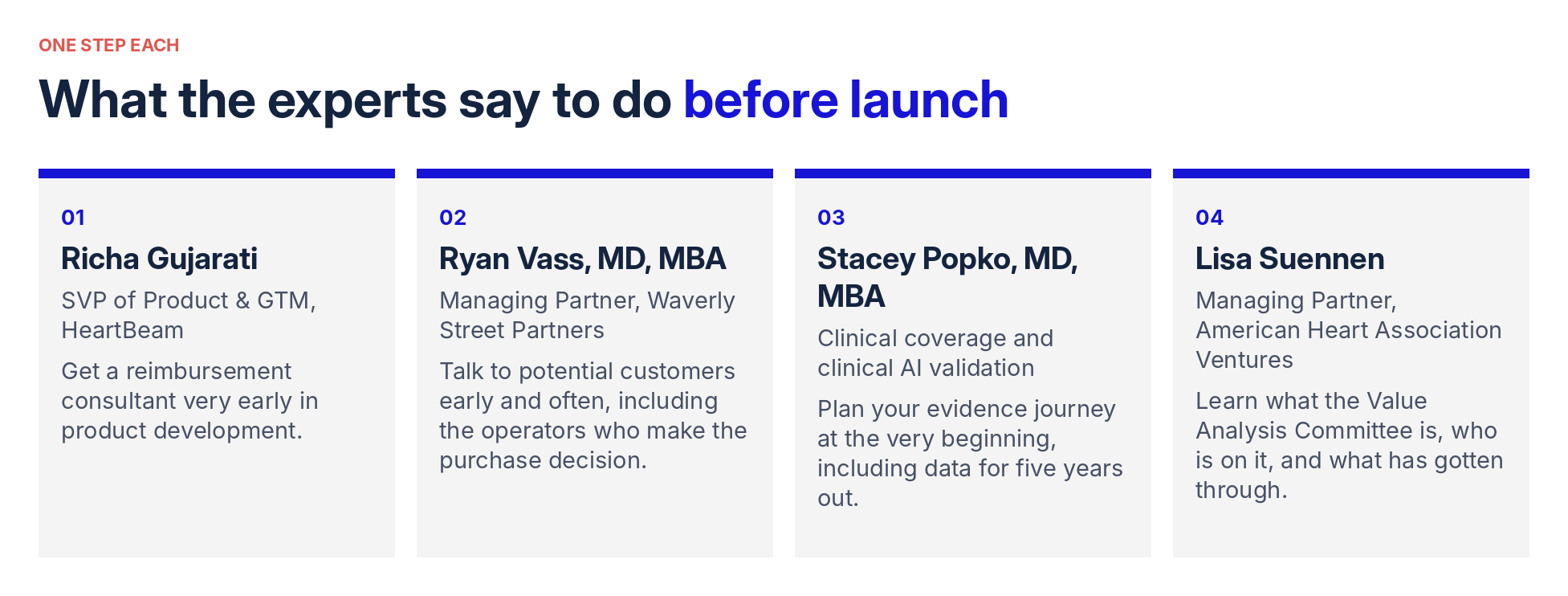
Each expert offered one concrete step:
Richa Gujarati: Get a reimbursement consultant very early into your product development. Her example: a core requirement of a DME code is demonstrating that your hardware can last three years, which a lot of people don’t recognize, and without testing for it and building it in as a spec, you’ll have a hard time with DME as a pathway.
Ryan Vass: Talk to your potential customers early and often, specifically the operator who makes the decision in each segment.
Stacey Popko: Think about your evidence journey at the very beginning. Have your 16-week study, but know you need data for five years out.
Lisa Suennen: If you don’t know what the Value Analysis Committee is, learn it. Find out who’s on it, and what has gotten through it successfully and what hasn’t.
Clinical value alone doesn’t get a product paid for. The decisions that determine reimbursement, from the evidence you plan for to the code your billing relies on, get made early, long before launch.
Watch the full conversation
These insights come from Cracking the Code on Reimbursement, a webinar MDisrupt hosted with all four experts, moderated by Lisa Suennen. The full recording is available on demand: Watch the webinar
If reimbursement strategy is something you’re working through now, MDisrupt can connect you with market access, payer strategy, and coding experts who have made these decisions from the other side of the table. Tell us what you’re working on.
The views, figures, and policy claims above are the speakers’ own, shared in a live discussion. MDisrupt hasn’t independently verified them, and reimbursement rules change, so check current payer and CMS guidance for your product.